

At the invitation of AZUS-CZ, around 70 EMU members, Board members, European partners and invited speakers came together in Prague for the 51st EMU General Assembly, the EMU Forum and Conference 2026.
Over several days, the programme moved from EMU’s strategic development to concrete project work. The Conference then opened the perspective further, with contributions on democracy, participation, student voice, SCHEME and European advocacy.
Together, these formats showed how EMU’s European voice is built: through the expertise of its members, strong cooperation with partner networks and the ability to connect music and art schools with wider discussions on education, culture, participation and democracy.
European Music School Forum: connecting members through CC-ECME
The European Music School Forum continued this strategy in a very concrete way. Its focus was closely connected to the CC-ECME project and to one of EMU’s central advocacy priorities: that every child growing up in Europe should have free access to Early Childhood Music and Arts Education (ECME).
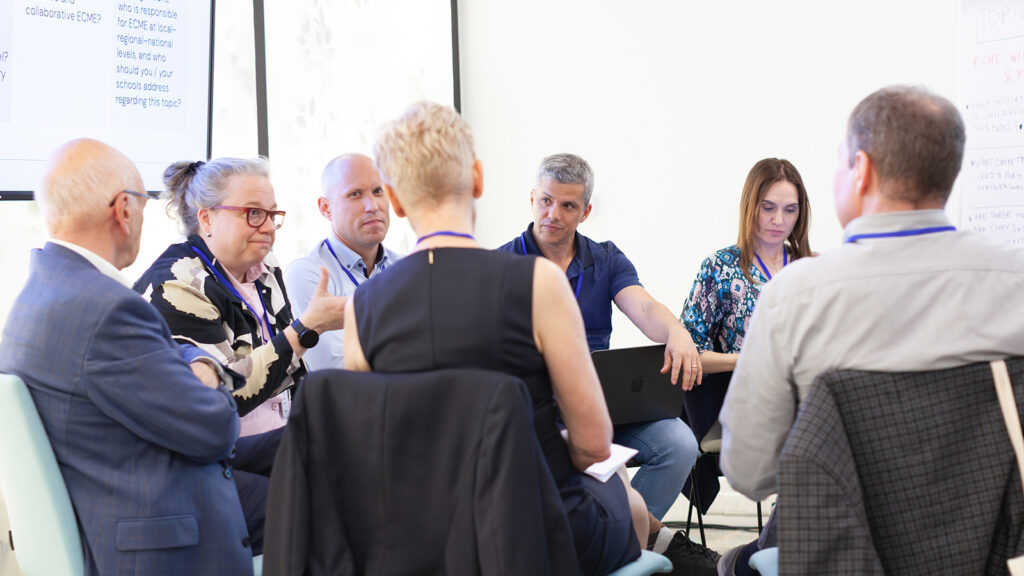
The working groups focused on inclusive and collaborative ECME, teacher competences and advocacy. Members contributed practices and experiences from different countries, systems and institutional contexts. The discussions showed how much knowledge already exists within the EMU community and how relevant ECME is in promoting equal access, active participation and inclusion in music and arts education.
The results of the Forum will feed directly into the next CC-ECME workshops in Vienna this September. In this way, the workshops became part of an ongoing process in which members’ experiences, questions and expertise contribute to the further development of shared arguments, tools and perspectives.
EMU Conference 2026: Leading Voices
Under the title Leading Voices: Advocacy, Democracy, and Music & Arts Education, the EMU Conference 2026 took place for the first time in a hybrid format. It created a space for participants from across Europe to exchange ideas on democracy, participation, advocacy, and the role of music and arts education in society. As the conference unfolded, it became clear that these topics are not abstract ideas, but are closely connected to the everyday realities of music and arts schools across Europe.
Tuulikki Laes from Uniarts Helsinki opened the conference with a keynote on music educators as transformative practitioners by choice. She reflected on the tensions that are part of music education, for example between a musical and a social focus, or between conserving traditions and keeping them alive. Rather than resolving such tensions too quickly, she invited participants to understand them as potentially productive. Her reflection on democracy as an ongoing struggle between equality and liberty felt particularly relevant in the current political climate. It reminded us that democracy cannot simply be taken for granted, but has to be kept alive through practice, dialogue and repeated negotiation. This also resonated strongly with music and arts education, where questions of participation, freedom, equality and belonging are negotiated every day.
Mimi Harmer then brought the discussion into the field of student participation. Drawing on her experience in building EPASA, the student association of AEC, she offered insights into how student voice can be strengthened in music education institutions. Her presentation moved through images of children’s playgrounds — spaces of movement, risk, trust and interaction. Like a swing, participation sometimes needs a first push to get moving. It needs space, time, encouragement and concrete opportunities to become part of institutional life. For music and arts schools, this raised an important question: how can we create the conditions in which young people are not only invited to participate, but are given the trust and support to actually do so?
Both keynotes were guided with great sensitivity by EMU Board members Csilla Gál and Olli-Pekka Martikainen. Their questions opened up connections between the keynote perspectives and the everyday practice of music and arts schools in Europe, building a bridge between theory, policy and institutional realities.

Connecting the field through SCHEME
From these reflections on democracy, participation and institutional practice, the conference turned to the question of how European networks can work together in music education. AEC Secretary General Finn Schumacker and EMU President Michaela Hahn presented SCHEME, the ongoing cooperation between AEC, EAS and EMU. Together, these networks connect the whole field of institutionalised music education in Europe: from children in music and art schools and pupils in general education to higher music education, professionals and adult learners.
A first insight was given into the upcoming joint SCHEME campaign, which aims to strengthen the political recognition of music and arts education at European level and contribute to policy discussions on EU funding. The campaign reflects a shared responsibility across the sector and shows how European networks can work together to make the value of music and arts education visible.
Advocacy as a systemic task
The EMU’s advocacy work was presented by EMU board members Robert Vroegindeweij, David Lalloz and Olli-Pekka Martikainen. Their contribution showed how EMU understands advocacy: making the value of music and art schools visible through evidence, collaboration and shared practice, and connecting the everyday work of members with wider policy discussions. Advocacy was discussed as a systemic task that takes place at different levels, with different actors and in close connection with the realities and needs of members.
Shared perspectives, new connections
The programme concluded with the new format Meet our Members, dedicated to AZUŠ ČR as this year’s hosting association. Moderated by EMU President Michaela Hahn and EMU Vice-President Romain Asselborn, the exchange offered valuable insights into the Czech music and arts school system and showed once again how diverse and locally rooted the systems across Europe are — and how much knowledge, experience and inspiration they can offer to one another.
Across the days in Prague, the programme created exchange on many levels: between members, board members, partner networks, speakers and different national contexts. It offered strategic orientation, concrete project work, new insights and discussions that will continue beyond the event itself.
What made the conference especially valuable was the openness with which participants shared knowledge, practices and experiences. Through this exchange, the EMU network gained much more than individual insights: new connections were created, the understanding of different systems and contexts was deepened, and the basis for future cooperation was strengthened.
Links


