

A swing does not move by invitation alone. There is a moment of waiting, perhaps a little hesitation — and then someone gives a first push. Not to control the movement, but to make it possible. After that, something begins to move on its own.
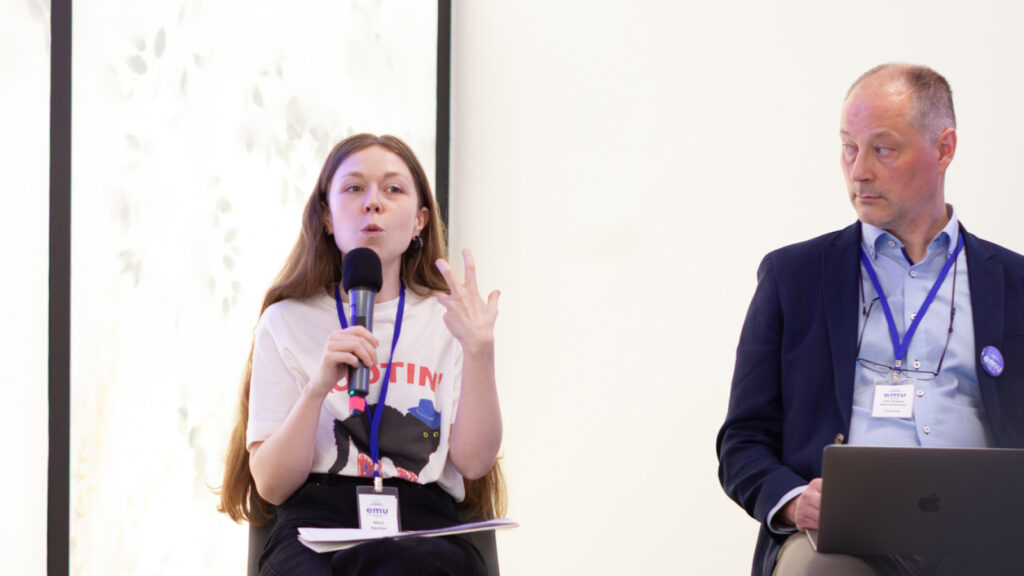
Drawing on her experience in building EPASA, the student association of AEC, Mimi Harmer shared insights into how student voice can be strengthened in music education institutions. Her presentation moved through images of children’s playgrounds: spaces of movement, risk, trust and interaction. Playgrounds are not empty spaces. They are carefully shaped environments where children can try things out, meet others, make decisions, take small risks and discover their own agency.
This image stayed with us. As EMU board member Olli-Pekka Martikainen reflected afterwards, perhaps from now on, whenever we see a playground, we will not only think of Mimi Harmer’s contribution, but also of the perspectives, impulses and innovative energy that student participation can bring to our music and arts institutions.
Because participation is not created by simply saying: “You are invited.” It needs space, time, encouragement, trust and concrete opportunities. It needs adults who are willing to listen, institutions that are willing to change, and young people who experience that their voices are not only heard, but taken seriously.
For music and arts schools, this opens an important question: how can we create the conditions in which young people are not only invited to participate, but are supported to actually do so?
Student participation is not an extra activity at the margins of institutional life. It is part of how we understand education. If music and arts schools are places where young people learn to express themselves, to listen, to collaborate and to shape something together, then participation belongs at the very heart of our work. It is also one of the ways in which children and young people can experience democracy from an early age: by learning that their voices matter, that listening and being listened to are connected, and that shared decisions can shape a common space.
It can begin in very small ways: asking students what they need, involving them in concert formats, giving them a role in welcoming artists, inviting them into evaluation processes, or creating student groups that help shape school life. But small steps can become a culture. And culture changes when young people are trusted not only as learners, but also as contributors.
Student Representation in Europe
Across Europe, many inspiring examples already show what this can look like. The Culture Crew model in Sweden, Denmark and other Nordic countries gives children and young people active roles in organising cultural events. They become hosts, communicators, technical supporters, decision-makers and ambassadors for culture in their schools and communities.
In Finland, the Vision 2030 for Finnish Music Education offers another inspiring example: developed as a shared process across the music education sector, it also included young people’s perspectives on what music education in 2030 could and should become. Students were invited to reflect on the future of music-making, the value of music for young people, and the skills that future music professionals will need. Their answers highlight cooperation, communality, compromise, creativity and self-expression — exactly the qualities that make student participation so essential.
The EMU has already started to collect such examples and materials. The Swedish poster Amplifying Student Voices: Enhancing Participation in Music and Art Schools, presented at the General Assembly 2024 in St. Pölten, offers a very practical planning checklist. It reminds us that participation needs four things: space, voice, audience and influence. Young people need accessible spaces to take part, different ways to express their views, people who truly listen, and visible influence on decisions and developments.
This is also where the work of the EMU will continue. The EMU Board has implemented student participation as one of its central strategic aims for the period 2024–2027. At the European Music School Forum 2026, first reflections on a European level were developed by looking at the AEC and EPASA model and discussing what EMU can learn from this experience.
Student participation will therefore remain both a strategic priority within the work of the EMU Board and an ongoing practice in our member countries. It asks us to keep learning, to keep opening doors, and sometimes to give that first push — until participation becomes part of the rhythm of our schools and becomes one of the many ways in which democratic culture can be lived, learned and strengthened from an early age.
Because when young people help shape music and arts education, they do not only participate in institutions. They help us imagine what our institutions can become.
Links
Amplifying Student Voices: Enhancing Participation in Music and Art Schools
Swedish planning checklist on student participation, presented at the EMU General Assembly 2024 in St. Pölten.
Download (Member Exclusive Content)
KulturCrew Denmark / Students as Organisers:
The Danish KulturCrew page explains that the “Students as Organisers” concept originated in Norway in 2006 and was later adapted in Denmark, Finland and Sweden.
kulturcrew.dk
KulturCrew Sweden:
KulturCrew describes itself as a model that promotes young people’s participation by bringing children, young people and adults together to organise cultural activities.
kulturcrew.se
Vision 2030 for Finnish Music Education:
The Finnish Vision 2030 is described as a shared response by the Finnish music education sector to future challenges, aiming for greater equity, impact and sustainability.
Finnish Vision 2030
Mimi Harmer
mimiharmer.com
EPASA – European Performing Arts Students Association
epasa.eu


